Angel Number 29: Why Some Readings Keep 11 Instead of 2
The birthday input, reduction rule and symbolic conventions behind 29's intuition and reunion readings
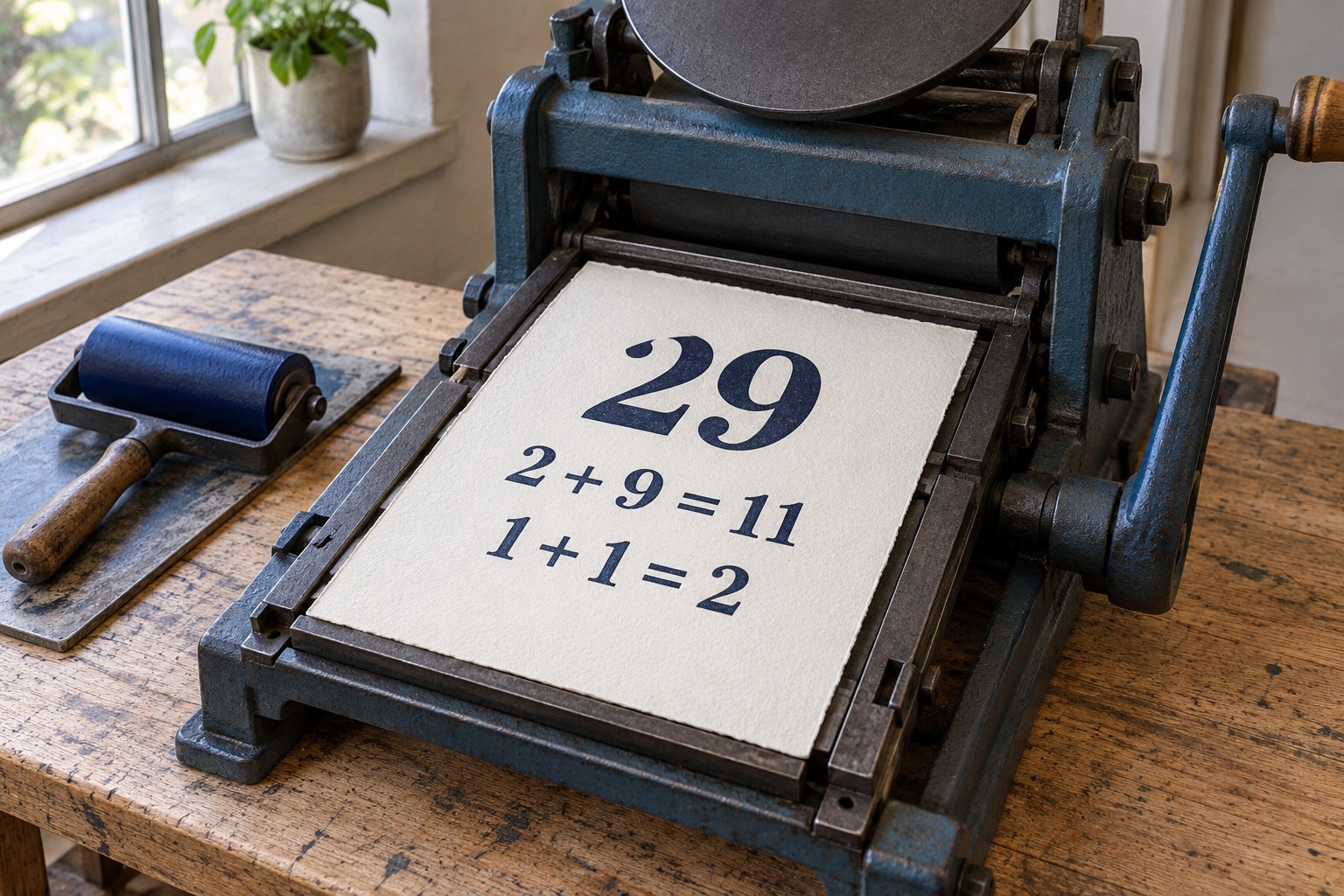
Twenty-nine produces two answers because a numerology reading can stop before the final digit sum. The operations 2 + 9 = 11 and 1 + 1 = 2 are both correct; the rule that gives one result interpretive priority comes from the method.
That rule also has an input: Decoz's profile of someone born on the 29th does not describe everyone who notices 29. A birthday, a chart calculation and a numeral encountered after a breakup are separate situations.
Quick Facts
- First digit sum
- 2 + 9 = 11
- Single-digit root
- 1 + 1 = 2
- Decoz's master set
- 11, 22 and 33; not 29 itself
- Day-29 birthday profile
- 11 retained; input is the day of birth
- Tarot XI
- Justice in Rider-Waite-Smith; Strength in Marseille
- February 29
- Exists only in a leap year
Does angel number 29 stay at 11 or reduce to 2?
The first sum is 2 + 9 = 11. A method that continues to a single digit then adds 1 + 1 = 2.
Keeping 11 is a stopping rule, not an alternative sum. Decoz's master-number set contains 11, 22 and 33, so 29 itself is not one of those numbers.
Decoz's birthday-number 29 profile retains the intermediate 11 and describes its sensitivity and intuition.
That portrait applies to a birth on the 29th of a month, rather than to 29 appearing on a receipt.
His master-number explanation reduces these numbers in time cycles and generally retains them in name-based calculations. A Personal Year and a name-based chart position therefore do not take their meaning from the same rule.
| Reading | Treatment of 29 | What the result describes |
|---|---|---|
| Decoz, day-29 birthday | 2 + 9 = 11; retain 11 | An attributed birthday-number profile |
| Decoz, time-cycle reduction | Continue from 11 to 2 | A cycle result under that calculation rule |
| Joanne and Andrews, angel-number 29 | Use the intermediate 11 | Their interpretation of an encountered number |
| Straight single-digit calculation | 2 + 9 = 11; 1 + 1 = 2 | The digital root, without a prediction |
The birthday row does not supply a Life Path calculation. A Life Path 11 requires the full birth date and a method that preserves the relevant master result; the day alone cannot establish that chart position.
Decoz connects master number 11 with the sensitivity and intuition he associates with 2. This relationship explains why the two profiles share some vocabulary, but it does not make their stopping rules or inputs identical.
Joanne's Sacred Scribes entry links angel number 29 with angel number 11, and Blair Andrews also gives the intermediate 11 interpretive weight. They apply that language to an encounter with 29, whereas Decoz's birthday portrait starts from a birth day.
The neighboring 28 first sums to 10, so its reduction takes a different intermediate step. Reversing 29 to 92 preserves the sum 11 because addition does not depend on the order of the two digits.
The reversal cannot turn those digits into a timetable of life events. Any claim that cooperation must happen before an ending is an interpretation added to the number, not a consequence of 2 + 9.
What do intuition, spiritual purpose and tarot XI add to 29?
Decoz calls 2 a peacemaker and associates it with understanding other people's motives.
His account of 9 emphasizes human connection and describes finality when 9 appears in a cycle.
These are descriptions with specified contexts. Combining the digits does not establish that a particular relationship has ended or that the person noticing 29 has read someone else's motives correctly.
Joanne's 2011 entry offers a more direct promise: a recent loss will be replaced by something positive.
She also connects 29 with lightworking, understood in her reading as spiritual service or purpose.
A prediction of replacement goes further than Decoz's description of a completing cycle. It proposes a future improvement without identifying a person, an opportunity or a date that would establish the outcome.
Decoz's day-29 portrait includes emotional extremes alongside intuition. Both traits belong to the same birthday interpretation; selecting only intuition would leave out part of that account.
The portrait supplies no clinical test for deciding whether a feeling after a loss is grief or accurate insight. Writing the feeling down can record it, but neither the birthday profile nor the number turns that record into a diagnosis.
Andrews adds a tarot correspondence: 2 becomes the High Priestess, 9 the Hermit and 11 Justice. The final match uses a deck-numbering convention as well as a numerological sum.
| Deck convention | Card XI | Where Justice appears |
|---|---|---|
| Rider-Waite-Smith | Justice | XI |
| Tarot de Marseille | Strength | VIII |
In the Marseille convention, reaching 11 would therefore point to Strength rather than Justice. The arithmetic has not changed; the symbol attached to XI has.
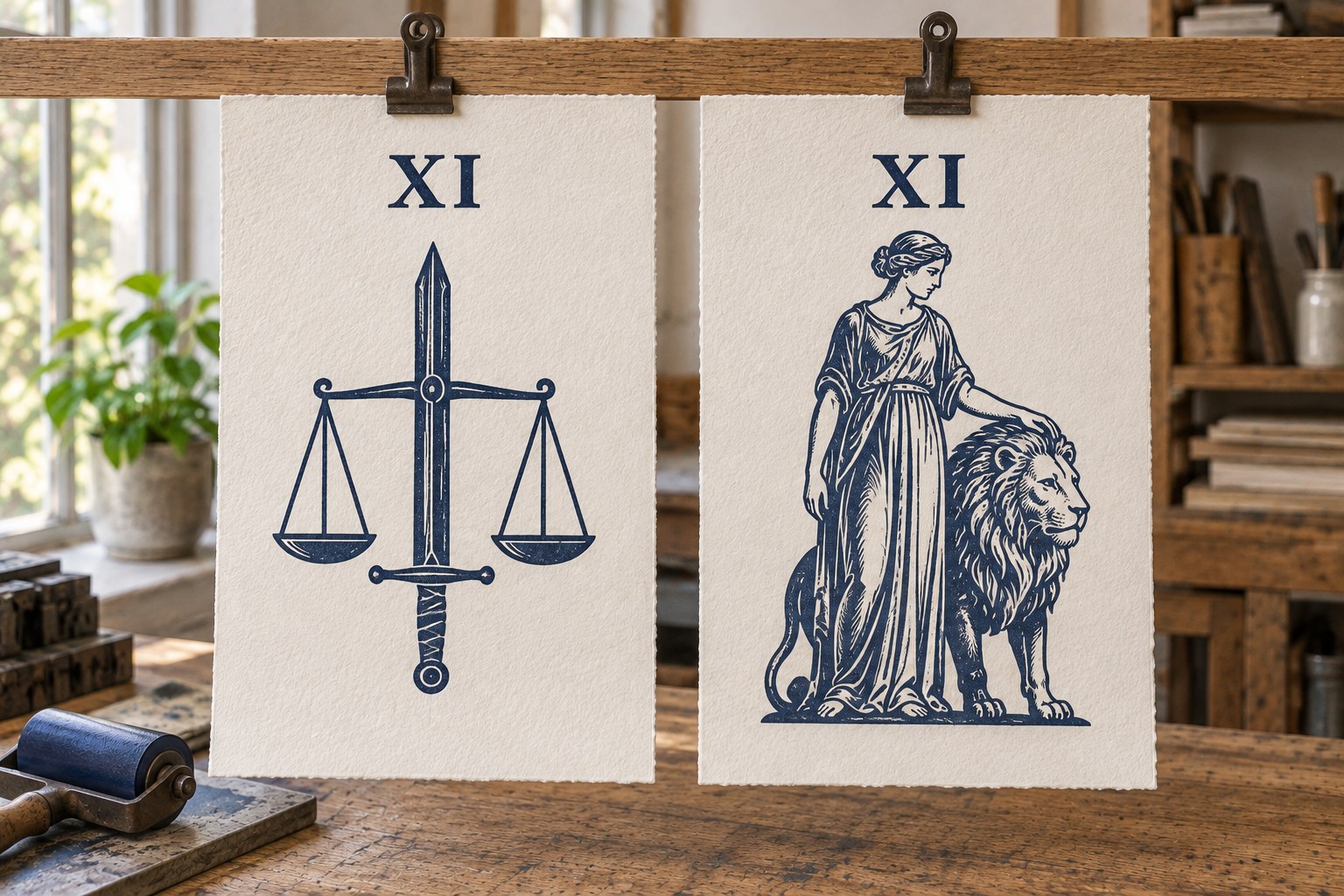
The table concerns card numbering, not a claim that the two traditions interpret 29 identically. Andrews' Justice association belongs to his chosen mapping rather than to every tarot deck or every person who sees 29.
Does 29 promise a reunion or a new job after an ending?
Seeing 29 does not establish that an ex-partner wants to return.
A breakup supplies the context in which the number feels relevant, but it does not supply the other person's wishes.
Joanne's promise of positive replacement does not specify reconciliation with the same person. A new relationship, a changed priority and renewed contact are different events; the promise identifies none of them.
An intuition may be about the former relationship, while Decoz's day-29 profile is about the person whose birthday supplies its input. Applying that profile to an ex simply because 29 appeared changes the subject without new evidence.
For example, a hypothetical friendly message says that someone has made contact. An explicit proposal to discuss restarting the relationship says something more specific, although even that proposal does not establish mutual agreement.
The distinction matters for twin-flame interpretations that present 29 as a reunion sign. An interpretation of a number does not establish a shared intention between two people.
The same input problem affects career and purpose readings. Decoz's humanitarian association with 9 and Joanne's lightworking language describe service-related ideals, rather than an employer's decision to offer a role.
A hypothetical team may finish a project because its work has been delivered, while its members continue in their jobs. Completion of that project is not automatically a career change, and seeing 29 adds no new employment terms.
A personal commitment to service and an offered position also answer different questions. The first concerns someone's aims; the second requires an actual opportunity with duties, conditions and agreement.
Why can 29 keep appearing on dates and displays?
Every Gregorian month except February in a common year contains a 29th. February 29 exists only in a leap year, making that birthday or anniversary a different calendar case from May 29.
A person born on May 29 still supplies Decoz's day-29 input. The fact that February 29 is rarer does not turn every repeated 29 into a leap-day birthday reading.
A minute display can also show 29 because ordinary clocks run through minute values from 00 to 59. The minute value does not specify anyone's birth date or the stage of a relationship.
The American Psychological Association describes selective attention as concentrating on some stimuli while filtering out others. A meaningful date or a recently encountered interpretation can make a matching number stand out among other figures.
Recurring numbers can become more noticeable without appearing more often.
Remembering the matches alone leaves the unremembered numbers out of the comparison.
Sources
- (n.d.). Numerology Meaning of number 2. World Numerology. Link
- (n.d.). Numerology Meaning of number 9. World Numerology. Link
- (n.d.). Master Numbers 11, 22, 33. World Numerology. Link
- (n.d.). Numerology Meaning of a 29 Birthday. World Numerology. Link
- (2011). Angel Number 29. Sacred Scribes Angel Numbers. Link
- (n.d.). Angel Number 29: Hidden Scales Behind the Curtain. Numerologist.com. Link
- (n.d.). Justice (tarot card). Wikipedia. Link
- (2018). Selective attention. APA Dictionary of Psychology. Link
About Our Editorial Process
Every KnowTheAngels guide separates calculation method, tradition context, and personal reflection. We cite where interpretations come from, present more than one view, and never present symbolic reading as prediction.
Read our editorial policy