What Does Angel Number 39 Mean for Communication, Completion, and Renewal?
The 39 to 12 to 3 calculation, competing interpretations, and the different things counted as forty less one
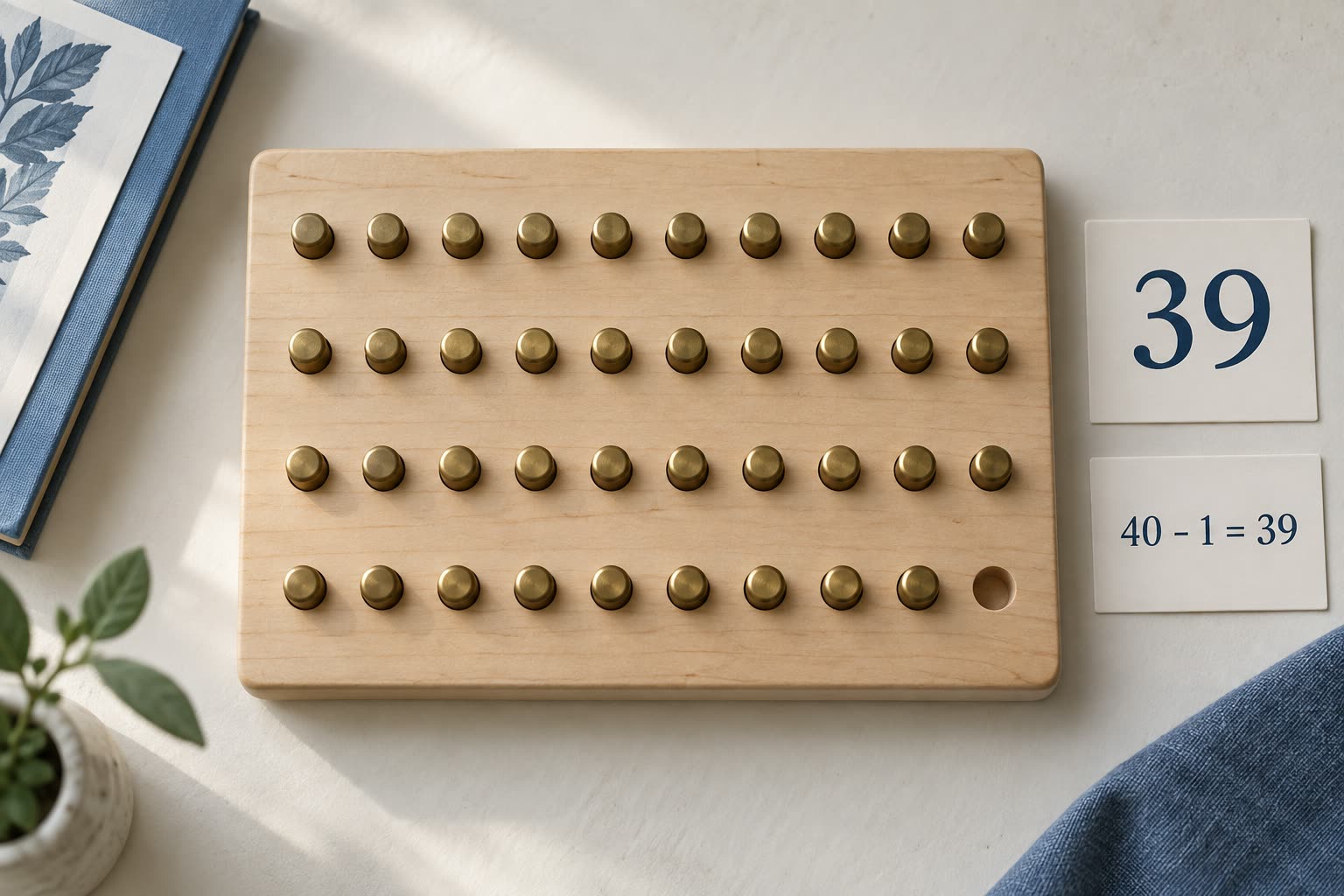
Angel number 39 is associated with communication, completion and renewed expression in some modern readings. Joanne Walmsley connects it with life purpose and spiritual support, while Blair Andrews develops a story of creative expression returning after an ending. Those are interpretations you can compare; seeing the number does not establish that a relationship or project is ending.
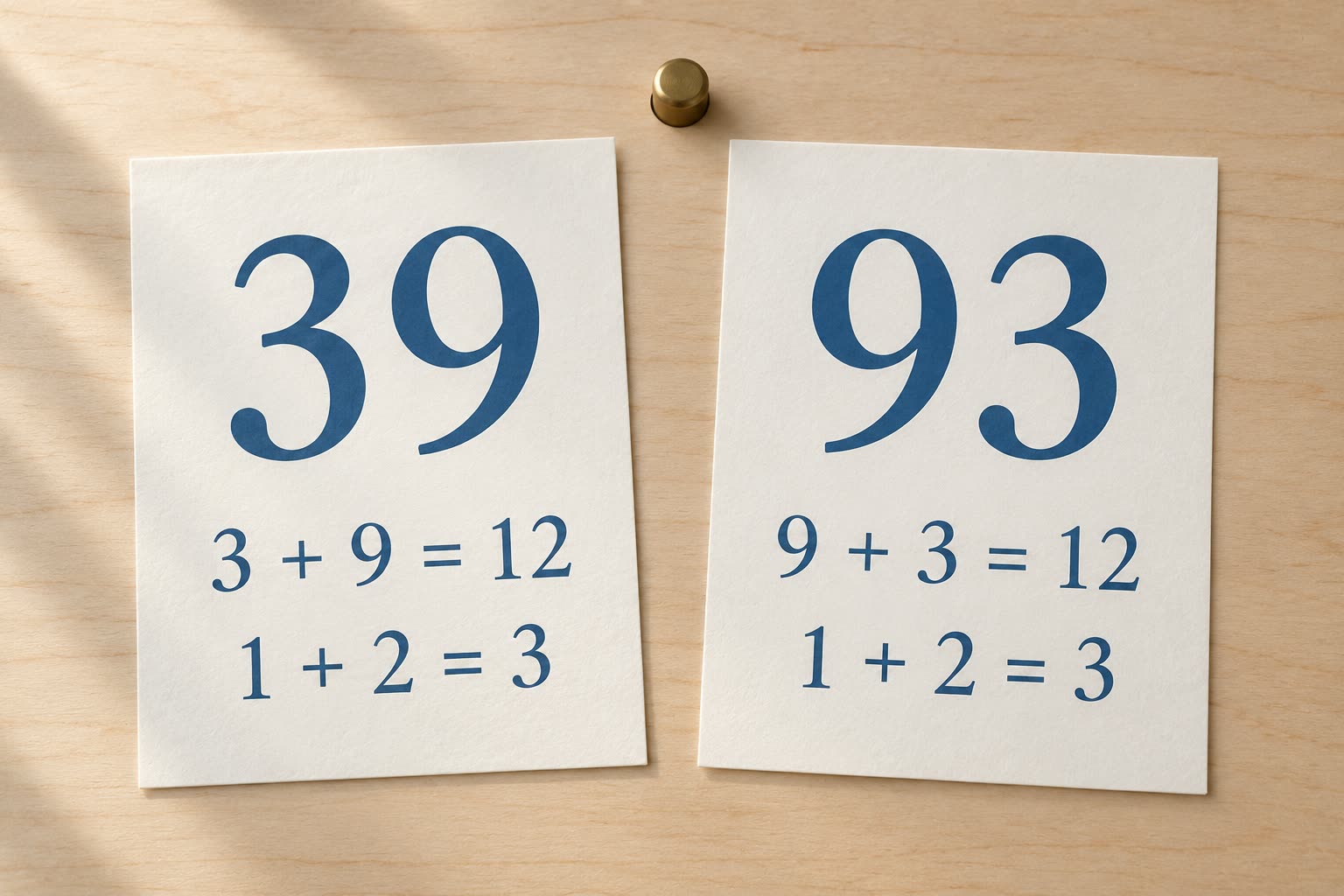
Its digit sum is 3 + 9 = 12, followed by 1 + 2 = 3. Cheiro gave 39 the same compound meaning as 30, whereas Andrews distinguishes their paths to 3. Biblical and Jewish uses of thirty-nine answer a separate question: what is being counted as forty less one?
Quick Facts
- Digit sum
- 3 + 9 = 12; 1 + 2 = 3
- Reversed numeral
- 93 has the same sum of 12, despite a different decimal value
- Smallest sum of 12
- 39 is the smallest positive integer with this digit sum
- Cheiro's compound entry
- 39 has the same meaning as 30
- Paul's count
- Five occasions of forty less one (2 Corinthians 11:24)
- Modern interpretations
- Spiritual purpose in Walmsley; creative return after an ending in Andrews
Where does the communication-and-completion reading of 39 come from?
The communication-and-completion reading combines two different sorts of association. In her July 2, 2011 entry, Walmsley connects 3 with self-expression and communication, 9 with spiritual enlightenment, and 39 with life purpose and a soul mission. Her references to angels and Ascended Masters belong to a modern devotional interpretation. They do not show that a particular sighting comes from an identifiable spiritual sender.
Andrews gives completion a more specific role in her account of 39. She imagines creative expression that returns after an ending, changed by the experience. That narrative can describe a second edition, a return to painting or a new way of speaking about finished work. It is the author's interpretation of the number, rather than a sequence demonstrated by adding its digits.
| Source | Reading of 39 | What the claim depends on |
|---|---|---|
| Joanne Walmsley, Angel Number 39 (2011) | Spiritual support for life purpose and a soul mission | Belief in an angel-number interpretation |
| Blair Andrews, Angel Number 39 | Expression returning after an ending | Her creative-cycle narrative and symbolism |
| Cheiro, chapter XIII, entries 30 and 39 | Thoughtful deduction and retrospection; neither fortunate nor unfortunate | His compound-number system and the outlook he assigns to the person represented |
The differences matter when you are asking what 39 means spiritually. Walmsley's reassurance, Andrews' creative narrative and Cheiro's more detached retrospection do not form a single message that all numerologists agree on. A number on a receipt cannot tell you which interpretation its author intended, or establish that any of them predicts your circumstances.
Why does 39 pass through 12, and why did Cheiro equate it with 30?
The calculation is 3 + 9 = 12, then 1 + 2 = 3. Under ordinary single-digit reduction, 39 therefore has a root of 3. Walmsley also relates it to 12 and 3, preserving the intermediate sum as part of her symbolic reading.
Thirty-nine is the smallest positive integer whose digits add to twelve. A one-digit number cannot reach that sum. For a two-digit number, the units digit can be at most 9, so the tens digit must be at least 3; taking 3 and 9 gives the smallest possible number. This property identifies a place in the sequence of digit sums. It does not establish that a person is taking a longer path to expression.
| Numeral | Digit addition | Ordinary root |
|---|---|---|
| 39 | 3 + 9 = 12; 1 + 2 = 3 | 3 |
| 93 | 9 + 3 = 12; 1 + 2 = 3 | 3 |
| 30 | 3 + 0 = 3 | 3 |
| 12 | 1 + 2 = 3 | 3 |
Reversing 39 to 93 changes the quantity from thirty-nine to ninety-three, but addition gives the same sum. The reduction removes place value and order. A Chaldean compound reading can still distinguish the written numbers, because it assigns interpretations to compound entries rather than relying only on their final root.
Cheiro explicitly equates 39 with 30 in chapter XIII of his Book of Numbers (pp. 83-84). His entry for 30 concerns thoughtful deduction, retrospection and mental outlook, and he calls it neither fortunate nor unfortunate. The shared root alone would not prove that equivalence; it is a rule in his published compound list.
Andrews draws a different boundary. She attaches the symbolism of the Hanged Man, numbered XII, to the intermediate 12 and interprets it as a change of viewpoint before expression returns. The arithmetic explains why 12 appears. It cannot establish the Tarot interpretation, make every numerology method use Tarot, or turn surrender into a required step in your life. The disagreement with Cheiro remains a disagreement even though both calculations end at 3.
Why did Paul receive 39 lashes? What the Bible actually counts
Paul reports thirty-nine lashes on five occasions in 2 Corinthians 11:24. In the King James Version, he calls each punishment "forty stripes save one". The verse counts physical punishments he experienced; it is not an instruction for interpreting repeated sightings of 39.
Deuteronomy 25:3 sets an upper limit of forty lashes and says that the number must not be exceeded. Mishnah Makkot 3:10 states the forty-less-one count through an interpretation of the wording, while also recording Rabbi Yehuda's position in favor of forty. The sources therefore distinguish a stated maximum, a thirty-nine count, and a recorded disagreement. Calling the missing lash a universal spiritual protection would add a meaning these passages do not supply.
| Passage | Number and unit | What the wording establishes |
|---|---|---|
| Deuteronomy 25:3 | Up to 40 lashes | A maximum that must not be exceeded |
| Mishnah Makkot 3:10 | 40 less one, with a dissenting position for 40 | The count and its interpretive disagreement |
| 2 Corinthians 11:24 | 39 lashes on each of five occasions | Paul's report of repeated punishments, not one punishment of 195 lashes |
| Matthew 27:26; John 19:1 | No lash count stated | Pilate had Jesus scourged; these verses do not give a total |
Five times thirty-nine equals 195, but that total combines five occasions. It would misrepresent Paul's sentence to describe him as receiving a single 195-lash punishment. The wording ties the unit to each occurrence, and that relationship matters more than finding a symbolic meaning for the total.
The frequently repeated claim that Jesus received 39 lashes is a separate inference. Matthew and John describe the scourging ordered by Pilate without stating its number. Paul's count and the rabbinic discussion do not insert a numeral into the Gospel accounts. You can distinguish what the texts explicitly report from what a later retelling supplies, without claiming that the Gospels rule out every possible count.
Thirty-nine Sabbath categories and Old Testament books count different things
Mishnah Shabbat 7:2 uses forty less one for the primary categories of labor, including sowing, ploughing and carrying between domains. Here thirty-nine is a classification total. Sowing another row does not create a new category every time the action is repeated, so the list is not a schedule of thirty-nine tasks or a count of someone's actions during a day.
What does the same total count?
The entries organize kinds of work. The count does not measure how often a person performs an action.
The number describes the way the writings are grouped into books. It does not assign a meaning to a personal sighting.
The Protestant Old Testament has 39 books, a printed-Bible total noted by E. W. Bullinger in Number in Scripture. Jewish tradition counts the corresponding Hebrew Bible writings as 24 books. Different book divisions can change the total without supplying different numerical messages from the same writings. The thirty-nine count therefore needs its tradition and its unit beside it.
These uses share a numeral with Paul's punishment count, but their subjects differ. A lash is an occurrence, a labor category is a type, and a book is a division of a text collection. Combining them into a claim that 39 always means testing, completion or restraint would erase the distinctions that explain why each total appears.
Does 39 mean an ending in love, or a twin-flame reunion?
Seeing 39 does not establish that your relationship has reached an ending. Andrews' story can describe expression after something finishes, but the thing that finishes could be a period of long-distance living or a recurring disagreement rather than the relationship itself. The number does not identify which situation applies.
For example, the end of long distance may bring a conversation about rent, travel and time together. That conversation can lead to a different shared arrangement if both people want it. After a breakup, the same idea of renewed expression might describe a private account of what happened, a conversation both people request, or a clear farewell. Those outcomes differ because the people and their agreements differ, not because 3 has followed 9.
A twin-flame label cannot supply the missing agreement. Another person's willingness to speak or resume a relationship is information only they can provide. An ending does not guarantee later contact, and one more explanation is not automatically welcome because an author describes a return to expression.
The distinction also answers the idea that 39 favors one final closure conversation. The sources do not set a conversation count. A shared housing or parenting responsibility may require continuing communication after a separation, while someone who has declined contact may want none. The relevant question is what communication is actually agreed and required by the situation, rather than which digit is supposed to come next.
39 in creative work and career changes: what counts as finished?
A finished piece of creative work can still generate another task. An accepted publication proof may be followed by an invoice, a correction or a proposal for a new edition. Each has a different purpose, so completion does not mean that all later communication must stop or that every new idea must wait until every old task has disappeared.
Andrews' account of expression returning after an ending can be a metaphor for that experience. Its limit becomes clear in a concrete example: a publisher accepts your final proof, then a factual error is discovered. Correcting that error preserves the work's accuracy. It does not show that you failed to accept the 9, and the choice between a correction and a new edition depends on what needs changing.
| Situation | What still needs an answer | What completion means here |
|---|---|---|
| The final proof is accepted | Has the agreed work been delivered? | The commissioned version is complete, even if billing remains |
| A factual error is found | Can a correction address the error? | Accuracy can require a repair after acceptance |
| The scope or argument changes | Is a revised edition being commissioned? | A new agreement can define new work rather than silently extending the old task |
A handover also differs from a creative restart. Files, decisions and outstanding questions can remain relevant to a successor after your part is finished. Describing their status gives that person something they can use; simply calling a folder closed does not explain whether the work was delivered, cancelled or transferred.
For a career change, contractual dates and the actual offer determine when a role ends or begins. Walmsley's spiritual support does not establish a vacancy, a salary or the security of a new position. You may find personal meaning in 39 while explaining what you learned from previous work, but the numeral cannot settle those employment facts.
Seeing 39 in an age, clock or receipt: what is being counted?
Thirty-nine can be a quantity, a label or part of a larger display. Your age of 39 counts years; a page numbered 39 identifies a location in a book. Neither input is a Life Path calculation, which uses a complete birth date under a stated method. Nor can 39 be a Birthday Number based on the day of the month, since the calendar day cannot exceed 31.
On a clock, the minutes and the complete time supply different written inputs. The minute field 39 reduces to 3, but the full 24-hour displays 03:39 and 15:39 have different roots. Cropping off the hour changes the calculation; it does not reveal a message hidden inside the full time.
| Recorded input | Digit addition | Ordinary reduction |
|---|---|---|
| Standalone 39 | 3 + 9 = 12 | 12 to 3 |
| 03:39, full 24-hour display | 0 + 3 + 3 + 9 = 15 | 15 to 6 |
| 15:39, full 24-hour display | 1 + 5 + 3 + 9 = 18 | 18 to 9 |
| 39.50, all displayed numerals | 3 + 9 + 5 + 0 = 17 | 17 to 8; the decimal point is not a digit |
The last example adds the displayed numerals by convention. It does not change the monetary amount 39.50 or explain whether a purchase is affordable. A number journal that preserves the original time or price keeps the input available; a note containing only 39 cannot show which digits were omitted.
Selective attention, as defined by the American Psychological Association, directs awareness toward some stimuli while others are ignored. Once you associate 39 with an ending, a matching receipt or clock reading may stand out among many ordinary displays. That is a possible explanation for noticing the number, not proof that every sighting has the same cause.
A record containing only the matches cannot establish that 39 is unusually frequent or that it clusters around endings. The comparison would also need the other observations and the occasions when no ending occurred. The spiritual interpretation and the frequency question can remain separate: personal meaning does not by itself establish a pattern or forecast an event.
Frequently Asked Questions
Is 39 a lucky number?
Cheiro calls the compound interpretation shared by 30 and 39 neither fortunate nor unfortunate, tying it to the mental outlook of the person represented. Walmsley's spiritual reassurance and Andrews' creative-return narrative are more hopeful readings. None establishes that a sighting predicts a lucky event.
Did Jesus receive exactly 39 lashes?
Matthew 27:26 and John 19:1 do not state a lash count. The forty-less-one figure is explicit in Paul's account in 2 Corinthians 11:24 and discussed in Mishnah Makkot 3:10. Those sources do not establish the count in the Gospel scene.
Does 39 reduce to a master number?
No master-number stopping point appears in 3 + 9 = 12, then 1 + 2 = 3. The intermediate 12 is a compound sum. Andrews' use of the Hanged Man's XII symbolism does not turn it into master-number status.
Does seeing 39 mean I have to end something?
The sighting does not identify an ending or require one. The completion-and-return idea belongs to Andrews' interpretation; whether a task or relationship ends depends on the work, agreements and people involved.
Sources
- (2011). Angel Number 39 (posted July 2, 2011). Sacred Scribes Angel Numbers. Link
- (2026). Angel Number 39: The Number That Comes Back Through (published March 22, 2023, updated May 21, 2026). Numerologist.com. Link
- (n.d.). Cheiro's Book of Numbers, chapter XIII: compound numbers 30 and 39 (pp. 83-84). Herbert Jenkins; scanned text at Internet Archive. Link
- (1611). Deuteronomy 25:3; 2 Corinthians 11:24; Matthew 27:26; John 19:1: limits, reported punishments and Gospel scourging accounts. BibleGateway. Link
- (c. 200). Makkot 3:10 (forty lashes less one), William Davidson English edition. Sefaria. Link
- (c. 200). Shabbat 7:2 (the primary categories of labour, forty-less-one), William Davidson English edition. Sefaria. Link
- (1921). Number in Scripture, 4th edition: the 39 Old Testament books of printed Bibles. Eyre & Spottiswoode, London; scanned text at Internet Archive. Link
- (2026). Hebrew Bible (the Tanakh counted as twenty-four books). Wikipedia. Link
- (n.d.). Selective attention. APA Dictionary of Psychology. Link
About Our Editorial Process
Every KnowTheAngels guide separates calculation method, tradition context, and personal reflection. We cite where interpretations come from, present more than one view, and never present symbolic reading as prediction.
Read our editorial policy