What Does It Mean to See an Angel in the Clouds?
Who reads cloud shapes as angel signs, where clouds and angels meet in scripture, why the eye builds figures from vapor, and how to check a viral angel-cloud photo
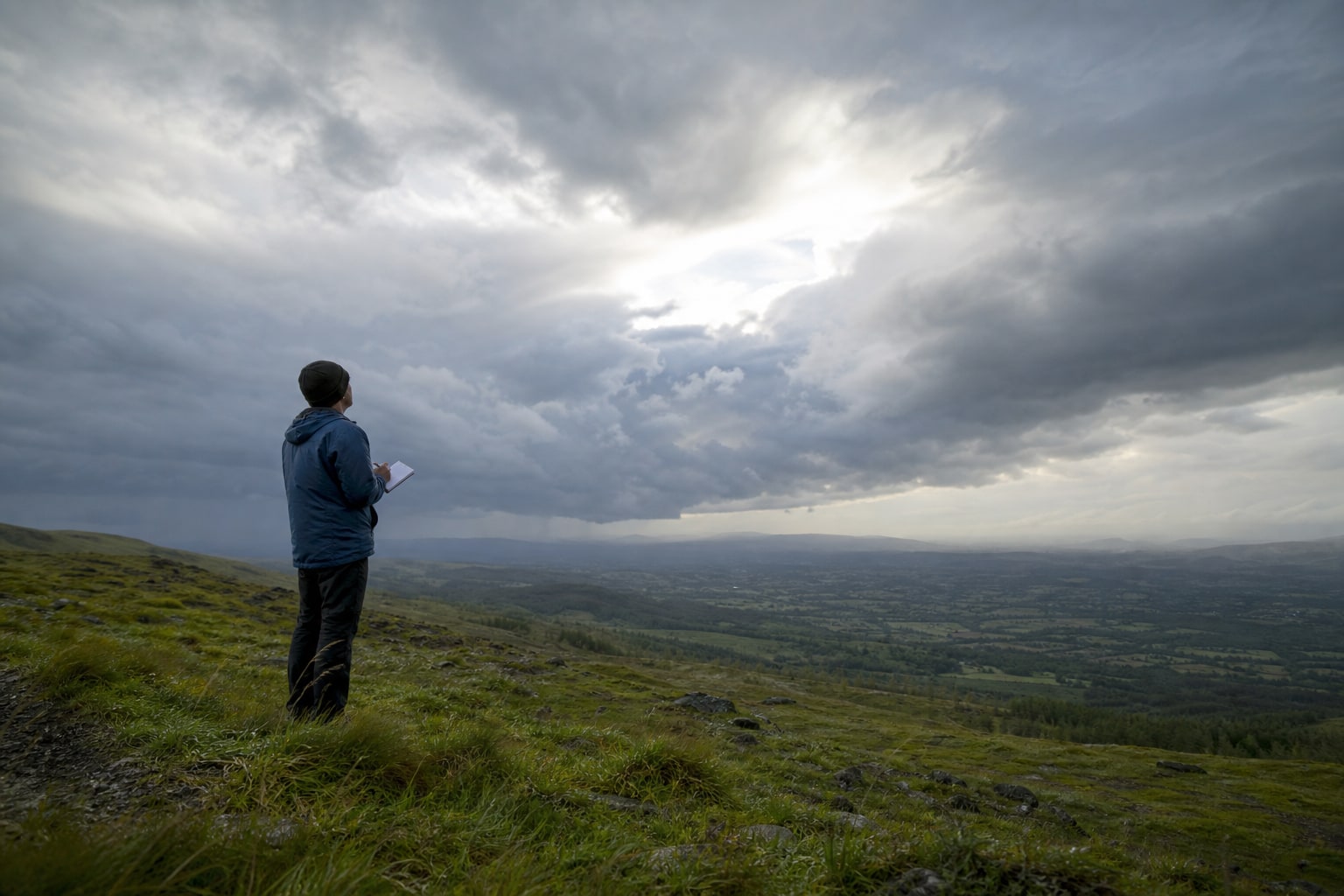
Seeing an angel in the clouds is read in popular belief as a sign of comfort, often from a guardian angel or from a loved one who has died. That reading belongs to modern angel-sign writers, and no photograph or cloud type can confirm it.
Scripture uses clouds differently. In Exodus, the Gospels, and Acts, a cloud marks where God is present and hides that presence at the same time, and only one vision, in Revelation 10:1, shows an angel wrapped in a cloud.
The shape has an ordinary cause as well: the visual brain completes faces and bodies from scraps of pattern, and wind, ice crystals, and low sunlight supply plenty of them.
Quick Facts
- Popular reading
- Comfort or a greeting from a guardian angel or a loved one; a modern belief, not a teaching of any scripture
- Closest biblical scene
- Revelation 10:1, a mighty angel coming down from heaven "wrapped in a cloud"
- Why the shape appears
- Pareidolia: the brain completes faces and figures from partial patterns within about a sixth of a second
- Common lookalikes
- Lenticular clouds, crepuscular rays ("Jacob's ladder"), hooked cirrus, and mammatus
- Radar "angels"
- The National Weather Service term for echoes from birds, insects, and air-density changes
What does it mean to see an angel in the clouds?
In popular angel-sign books, a cloud shaped like an angel is read as comfort: a greeting from a guardian angel, reassurance in a hard week, or a sign from someone who has died. It is a personal reading, and it works the same way whether the cloud lasted ten seconds or ten minutes.
Doreen and Charles Virtue's Signs from Above (Hay House, 2009) lists cloud shapes among the signs it credits to angels, including a cloud "in the perfect shape of an angel with her wings arched across the sky." Doreen Virtue renounced her earlier angel teachings after her conversion to Christianity in 2017, so the best-known author of this reading no longer stands behind it.
The Catechism of the Catholic Church affirms angels as "a truth of faith" and says human life is "surrounded by their watchful care" (paragraphs 328 and 336), yet it says nothing about reading them in cloud shapes.
| Who is reading it | What they say about the cloud | What that reading can carry |
|---|---|---|
| Popular angel-sign writers | Angels shape clouds to send comfort or a greeting | A personal sense of comfort; no test can confirm or rule it out |
| Jewish and Christian scripture | Clouds mark or hide God's presence; one vision shows an angel wrapped in a cloud | No passage treats a cloud's outline as a message to decode |
| Perception research | The brain completes faces and figures from partial patterns | Explains why the shape appeared; says nothing about what it meant to you |
Many people who search this question saw the cloud during grief, on a birthday, or on the day of a funeral. The meaningful coincidence of that timing is a separate question from the shape, and the shape alone cannot settle it.
What the cloud can do is hold a moment. A photo with the date, the place, and what you were thinking keeps that moment honestly, without asking the cloud to prove a visit.
Which Bible passages put an angel and a cloud together?
The Bible mentions clouds often, and nearly always to show God's presence while hiding it. Only a few passages put an angel and a cloud in the same scene, and none describes a cloud shaped like an angel.
The pillar of cloud comes first: "The Lord went in front of them in a pillar of cloud by day, to lead them along the way," says Exodus 13:21 (NRSVUE), with a pillar of fire to light the night.
Exodus 14:19 is the nearest thing in the Hebrew Bible to an angel in the clouds: "The angel of God who was going before the Israelite army moved and went behind them, and the pillar of cloud moved from in front of them and took its place behind them."
The angel and the cloud move together to stand between Israel and the Egyptian army. Readers have long debated whether the angel of God in scenes like this is a created angel or God's own presence, and the cloud does not settle it.
When the tabernacle was finished, "the cloud covered the tent of meeting, and the glory of the Lord filled the tabernacle" (Exodus 40:34). Moses could not go in, and at Solomon's temple the priests "could not stand to minister because of the cloud" (1 Kings 8:11).
Daniel 7:13 sees "one like a human being coming with the clouds of heaven." The Aramaic says "with," while the Old Greek translation reads "on the clouds," the wording Jesus uses in Matthew 26:64: "coming on the clouds of heaven."
Who that figure is stays disputed: Christian tradition reads him as Christ, many scholars as a symbol of faithful Israel, and the biblical scholar John Collins as the archangel Michael, whom Daniel 10 to 12 presents as Israel's champion in heaven.
| Passage (NRSVUE) | What the cloud does | Is an angel in the scene? |
|---|---|---|
| Exodus 13:21-22 | Leads Israel by day as a pillar | No; the text says the Lord went in front of them |
| Exodus 14:19-20 | Moves behind Israel and stands between the two armies | Yes; the angel of God moves with the cloud |
| Exodus 40:34-35; 1 Kings 8:10-11 | Fills the tent and the temple so no one can enter | No |
| Daniel 7:13 | One like a human being comes with the clouds | Disputed; some scholars read the figure as Michael |
| Matthew 17:5 | A bright cloud overshadows the Transfiguration and a voice speaks from it | No; the voice is God's |
| Acts 1:9-11 | Takes Jesus out of the disciples' sight | Two men in white robes stand beside the disciples |
| 1 Thessalonians 4:17 | Believers are caught up in the clouds to meet the Lord | No |
| Revelation 10:1 | An angel comes down from heaven wrapped in a cloud | Yes, in a vision |
At the Transfiguration, "a bright cloud overshadowed them, and a voice from the cloud said, 'This is my Son, the Beloved'" (Matthew 17:5). At the Ascension, "a cloud took him out of their sight" (Acts 1:9), and the two men in white robes who speak next, usually read as angels, stand on the ground beside the disciples.
Revelation 10:1 comes closest to the popular picture. John sees "another mighty angel coming down from heaven, wrapped in a cloud," his face like the sun and his legs like pillars of fire, and the cloud is the angel's clothing inside a vision.
A rainbow also sits over that angel's head, which many readers connect with the covenant bow of Genesis 9 and the bright bow around God's throne in Ezekiel 1:28.
The one time the Gospels talk about reading clouds, the subject is weather. "When you see a cloud rising in the west, you immediately say, 'It is going to rain,'" Jesus says in Luke 12:54, before asking why people read the sky better than the present time.
What is the Shekinah, and is it the cloud?
The Shekinah is the rabbinic name for God's dwelling presence, and the word does not appear in the Hebrew Bible. It comes from the Hebrew root meaning "to dwell," the same root as mishkan, the tabernacle the cloud filled in Exodus 40.
The Aramaic Targums, early Jewish translations of scripture, used presence words wherever the Hebrew described God in human terms, and the Talmud and Midrash made "Shekinah" the standard term. The Jewish Encyclopedia article by Kaufmann Kohler and Ludwig Blau (1906) traces that development.
In the Mishnah, Rabbi Halafta of Kefar Hanania teaches that "when ten sit together and occupy themselves with Torah, the Shechinah abides among them" (Pirkei Avot 3:6). His saying places the presence with people studying together, and no cloud appears in it.
Christian writers later joined the two ideas in the phrase "Shekinah glory," used for the pillar of cloud and the cloud over the tabernacle. That phrase is a later label; Exodus itself speaks of "the cloud" and "the glory of the Lord."
A bright cloud today is not the Shekinah in any sense the rabbinic sources use, and calling it that is a modern devotional step that adds to those texts rather than quoting them.
Why does the brain find faces and figures in clouds?
People see faces and figures in clouds because of pareidolia, the normal habit of the visual brain to find faces fast and complete one from very little.
In a 2014 study in the journal Cortex, Jiangang Liu, Kang Lee, and colleagues trained volunteers to spot faces hidden in visual noise, then showed them pure noise with nothing in it. The volunteers reported a face in 34 percent of those empty images.
Brain scans showed the face area of the visual cortex responding whenever a volunteer believed a face was there, with the frontal cortex supplying the expectation. The team titled the paper "Seeing Jesus in toast" because the same process explains holy faces seen in toast, stains, and clouds.
Susan Wardle and colleagues at the US National Institute of Mental Health found in 2020 that the brain first handles an illusory face much like a real one, at about 160 milliseconds, and files it as an ordinary object only by about 250 milliseconds.
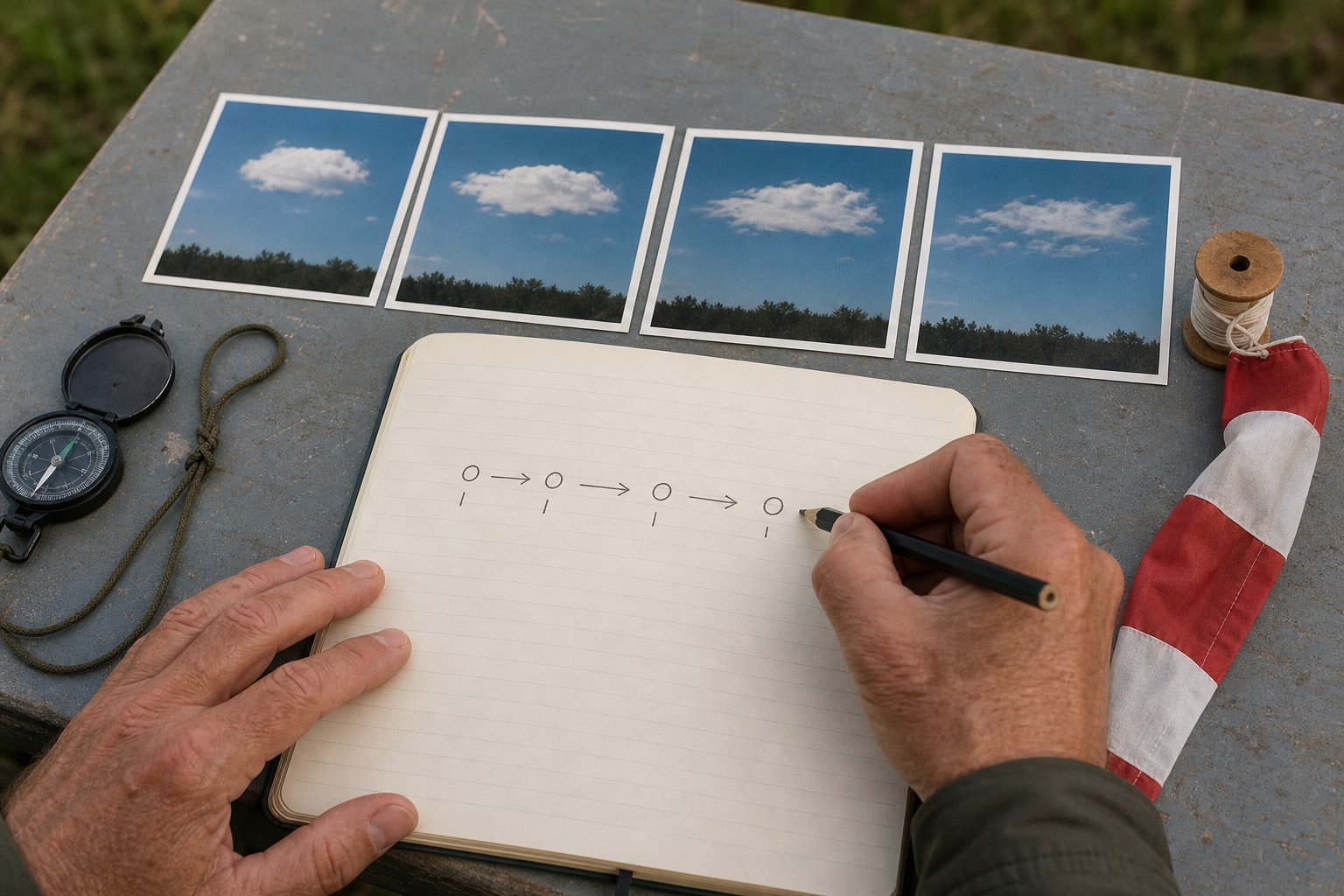
Expectation steers what the eye finds. In Hamlet (act 3, scene 2), Hamlet points to a cloud "almost in shape of a camel," then calls it a weasel, then a whale, and Polonius agrees each time: "Very like a whale."
A person thinking about a mother who has just died, or already praying for a sign, is primed to see wings the way Polonius was primed to see a whale. That priming does not make the comfort false; it explains why the figure seemed so clear.
The anthropologist Stewart Guthrie built a theory of religion on this habit. In Faces in the Clouds (Oxford University Press, 1993), he argued that people read humanlike agents into the world because missing a real one costs more than mistaking a cloud for one.
Guthrie's argument explains the seeing and leaves the believing open: a habit of spotting figures accounts for why a cloud looked like an angel, and it cannot show whether angels exist.
What does a cloud shaped like a feather or wings mean?
In popular belief, a cloud shaped like a feather or a pair of wings means an angel has passed by or is keeping watch. The reading has no scriptural source; it extends the modern belief that a white feather found on the ground is a sign from an angel or from someone who has died.
Angel-sign websites sort the shapes further, often reading a single feather as reassurance, spread wings as protection, and one wing as a loved one watching over the family. The lists change from one writer to the next, which shows they are personal readings rather than an inherited system.
In weather terms, most feather-shaped clouds are cirrus: thin cloud made of ice crystals about 8 to 10 kilometers up, where the air sits near minus 40 to minus 50 degrees Celsius. The Royal Meteorological Society explains the hooked kind, sailors' "mares' tails," as ice crystals falling out of the cloud while faster wind above pushes the top ahead.
The feather cloud does carry one dependable message: hooked cirrus often appears when a warm front is on its way, generally 12 hours or more before its rain arrives.
A wing shape is usually a cumulus or altocumulus edge stretched by wind, and it changes within minutes because the droplets that draw it keep forming and evaporating.
Which real clouds and light effects look like angels?
Four sky effects lie behind many genuine angel-cloud photos, and each has a known cause you can check against the time, place, and weather of the picture.
| Effect | What it looks like | What causes it | What to check |
|---|---|---|---|
| Lenticular cloud | Smooth lens or saucer, sometimes stacked, holding still | Air flowing over a ridge sets up standing waves; cloud forms at each crest | Hills or mountains upwind; strong gusts nearby |
| Crepuscular rays ("Jacob's ladder") | A fan of light beams from behind a cloud, sometimes reaching the ground | Sunlight through gaps in cloud; the beams are parallel and perspective spreads them | Sun low in the sky, near sunrise or sunset |
| Hooked cirrus | Thin white feather or hair with a curled tail | Ice crystals falling from high cloud and bent by wind | Very high, slow-moving cloud; a warm front may follow |
| Mammatus | Rounded pouches hanging under a cloud base | Forms beneath cumulonimbus storm clouds | Thunder, hail, or lightning nearby |
Lenticular clouds hold still while wind races through them, because new cloud keeps forming at the wave crest as the old cloud evaporates downwind. The Met Office calls them "one of the most common explanations for UFO sightings across the world," and a white, winged outline over a peak draws the same double take.

New Zealand's MetService lists "God rays" and "Jacob's Ladder" among the names for crepuscular rays. The second name comes from Genesis 28:12, where Jacob dreams of "a stairway set up on the earth, the top of it reaching to heaven," with "the angels of God" going up and down it.
Older English Bibles such as the King James Version translate that stairway as a ladder, and sunbeams slanting down through cloud took the name of Jacob's ladder from that wording. Genesis never mentions clouds or sunlight in the dream.
Mammatus is the one shape on this list that calls for action. The Met Office links it with storm clouds that bring hail, heavy rain, and lightning, so a pouched, glowing sky is a reason to check the forecast and get indoors first.
How can you tell whether a viral angel-cloud photo is real?
Many viral angel-cloud images are edited or generated by AI, and fact-checkers have traced several to a small number of accounts that post one miracle after another. Checking a clip takes a few minutes and uses the same steps they use.
In January 2023, PolitiFact rated false a Facebook video said to show an angel in the sky over Palestine. The TikTok account behind it had posted the same crowd pointing upward, with the same audio, under different figures pasted into the sky, including horses.
In May 2026, Lead Stories examined a video of a Jesus-shaped cloud filmed from a ship at sunset. The passengers' own phone screens showed a plain sunset with no figure, and three AI-detection tools flagged the clip as generated.
Five checks before you share an angel-cloud photo
- Look at the people
Do phone screens, shadows, and faces in the crowd match the sky? Blank phone screens, melted faces, and odd postures point to editing or AI.
- Search the image
A reverse image search with Google Lens or TinEye often finds the first upload and other versions with a different figure in the sky.
- Check the account
An account that posts a new apparition every few days, often with the same audio, is producing content rather than recording weather.
- Match the weather
A real photo has a place and a date. Satellite and radar archives for that day should show the right kind of cloud.
- Find a second angle
A cloud over a town is seen by many people, so a real one usually appears in more than one photo taken from different spots.
A genuine cloud that briefly looked like an angel leaves ordinary traces: other photos from the same hour, a cloud type you can name, and a shape that drifted apart. Photos showing glowing circles instead of figures are a different case, usually dust or droplets lit by the camera's flash.
Why do weather radars call birds and insects "angels"?
Weather radar has its own angels, and they are birds and insects. The National Weather Service glossary defines angels as "radar echoes caused by birds, insects, and localized refractive index discontinuities," the last meaning pockets of air with different temperature or moisture.
Radar operators began seeing unexplained echoes in clear air in the 1940s and nicknamed them angels because they came and went with nothing visible in the sky. By the late 1950s, British radar studies had tied many of them to migrating birds.
Some radar angels draw striking shapes. Birds leaving a roost at sunrise spread outward and show as a growing ring, and in 1997 a National Weather Service team from Binghamton, New York, went into the field and found one recurring ring was made "almost exclusively of several species of blackbirds."
On warm evenings the radar also shows a haze of echoes around the station, which forecasters call bloom. Insects taking flight at dusk cause much of it, and in spring and fall night-migrating birds add to it; the BirdCast project uses these same echoes to forecast bird migration.
A screenshot of an "angel" on radar is showing a 1940s nickname for echoes that are almost always birds or insects, which researchers read to count wildlife.
Frequently Asked Questions
Is seeing an angel in the clouds a sign from God?
No scripture or church teaching says so; the sign reading comes from modern angel-sign books, and the shape itself comes from pareidolia.
What is the spiritual meaning of seeing cloud formations?
There is no fixed symbolism for cloud formations. In popular belief, sunbeams through cloud or a still, saucer-shaped cloud are read as reminders of heaven or protection, and each formation also has a weather cause worth naming first.
Which angel in the Bible is wrapped in a cloud?
Revelation 10:1 describes "another mighty angel coming down from heaven, wrapped in a cloud," with a rainbow over his head. The passage does not name him, and it is part of John's vision rather than a sky event.
What kind of cloud looks like angel wings or a feather?
Usually cirrus, thin high cloud made of ice crystals whose falling streaks curve into feather and wing shapes. Hooked cirrus often comes about 12 hours or more before a warm front's rain.
Why are sunbeams through clouds called Jacob's ladder?
The name borrows Jacob's dream in Genesis 28:12, translated as a ladder in the King James Version, where angels go up and down between earth and heaven. The rays themselves are parallel sunlight spread into a fan by perspective.
Is the pillar of cloud the same as the Shekinah?
Not in the Bible's own words, because Shekinah is a later rabbinic term for God's dwelling presence, and the phrase "Shekinah glory" for the pillar of cloud is a Christian interpretive label.
Should I be worried about a strange, glowing cloud?
Only when it signals weather. Pouch-shaped mammatus clouds come with thunderstorms, so check a local forecast and move indoors if thunder, hail, or lightning is near.
Sources
- (2021). Exodus 13:21-22; 14:19-20; 40:34-38; 1 Kings 8:10-11 (New Revised Standard Version Updated Edition). Bible Gateway. Link
- (2021). Daniel 7:13; Matthew 17:5; Acts 1:9-11; Revelation 10:1 (NRSVUE). Bible Gateway. Link
- (2021). Matthew 26:64; 1 Thessalonians 4:17; Genesis 28:12; Luke 12:54-56 (NRSVUE). Bible Gateway. Link
- (2011). Old Greek Daniel 7:13-14 and Matthew's Son of Man. Bulletin for Biblical Research 21(4). Link
- (1998). The Apocalyptic Imagination, 2nd ed., pp. 101-103 (identity of the one like a son of man). Eerdmans
- (1906). Shekinah. Jewish Encyclopedia. Link
- . Pirkei Avot 3:6. Sefaria. Link
- . Shekinah. BiblicalTraining Library. Link
- (1993). Catechism of the Catholic Church, paragraphs 328-336 (The Angels). Libreria Editrice Vaticana. Link
- (2009). Signs from Above: Your Angels' Messages about Your Life Purpose, Relationships, Health, and More. Hay House. Link
- (2017). Doreen Virtue's conversion to Christianity sparks debate. The Wild Hunt. Link
- (2014). Seeing Jesus in toast: Neural and behavioral correlates of face pareidolia. Cortex 53: 60-77. Link
- (2014). A Closer Look at the Face in Your Toast. APS Observer. Link
- (2020). Rapid and dynamic processing of face pareidolia in the human brain. Nature Communications 11: 4518. Link
- . Hamlet, act 3, scene 2. Folger Shakespeare Library. Link
- (1993). Faces in the Clouds: A New Theory of Religion. Oxford University Press. Link
- . Hooked Cirrus. MetLink. Link
- . Unusual cloud formations (lenticular and mammatus clouds). Met Office. Link
- . Crepuscular Rays. MetService (New Zealand). Link
- (2023). Look, up in the sky! It's an angel, it's a horse, it's an altered video!. PolitiFact. Link
- (2026). Fact Check: Video Of Jesus-Shaped Cloud Is FAKE, AI-Generated. Lead Stories. Link
- . Glossary: Angels. NOAA National Weather Service. Link
- (1997). Radar and bird roost field study. NOAA National Weather Service, Binghamton. Link
- (2026). Radar angels. Wikipedia. Link
- . A primer for using weather surveillance radar to study bird migration. Cornell Lab of Ornithology, BirdCast. Link
About Our Editorial Process
Every KnowTheAngels guide separates calculation method, tradition context, and personal reflection. We cite where interpretations come from, present more than one view, and never present symbolic reading as prediction.
Read our editorial policy