What Does Finding a White Feather Mean in Spiritual and Angel Beliefs?
Where the angel-feather belief came from, the older British meaning it replaced, the ordinary places feathers come from, and whether you may keep one

In modern angel writing, a white feather means that an angel, or someone you loved who has died, is close and wants to reassure you. That reading took shape in popular angel books of the 2000s, and it sits on top of an older British meaning in which a white feather called a man a coward.
No feather can show who, if anyone, meant it for you. Birds replace their feathers all year, and feather pillows and duvets leak down, so most white feathers have a plain source.
What a white feather means to you can still matter, and whether you may keep it depends on which bird dropped it.
Quick Facts
- Popular meaning
- Comfort and closeness from an angel or from someone who has died, in modern angel writing
- Where the belief took shape
- Angel books of the 2000s, including a chapter called "Finding Feathers" in Doreen and Charles Virtue's Signs from Above (2009)
- Older British meaning
- Cowardice; women handed white feathers to men out of uniform from August 1914
- Usual ordinary sources
- Molting birds, down from pillows, duvets, and jackets, and gulls and pigeons
- Keeping one in the US
- Needs a permit for most native wild birds under the Migratory Bird Treaty Act; pigeon and poultry feathers are exempt
What does a white feather mean to people who read it as a sign?
Among people who believe in angel signs, a white feather usually means reassurance. The message read into it is that an angel, or a person who has died, is near and wants you to know you are not alone.
Doreen and Charles Virtue's 2009 book Signs from Above gives feathers a whole chapter, "Finding Feathers," and presents them as replies from guardian angels, often after a reader has asked for a sign.
Lorna Byrne, the Irish author of the memoir Angels in My Hair (2008), describes a feather as "one of the most common of all" the signs angels give.
Diana Cooper, a British angel teacher, put it more bluntly in 2015: "A white feather brings an angel message."
Three details recur in these accounts. The feather is small and white, it turns up somewhere unexpected such as a bedroom or a car seat, and it arrives soon after a prayer, a request, or a hard anniversary.
That meaning belongs to modern angel spirituality rather than to scripture. The Bible gives some angels wings, such as the six-winged seraphs of Isaiah 6:2, but no passage has an angel leave a feather behind or use one as a message.
The closest biblical image is Psalm 91:4: "he will cover you with his pinions, and under his wings you will find refuge" (NRSVUE). In the psalm the one with wings is God, and the wings are a picture of shelter, not an object that falls to the ground.
Is a white feather a sign from an angel or from a loved one who died?
Both readings come from the same popular tradition, and many people hold them together. The angel books speak mostly of guardian angels, while grief accounts shared in bereavement groups and online often take the feather as a greeting from the person who died.
Nothing about the feather itself can settle which one sent it, or whether anyone did. The choice between an angel, a parent, a child, or no sender at all comes from your own beliefs, and a feather gives the same evidence for each.
Grief research helps explain why the question can feel so urgent.
The psychiatrist Vamik Volkan used the term "linking objects" for things a mourner keeps because they seem to hold a thread to the person who died.
A 2026 study in BMC Psychology asked 250 bereaved adults about such objects, and 83.2 percent had kept at least one. Touching or holding them was not linked to heavier grief, but visiting them often, smelling them, and feeling pain while handling them were.
For a found feather, the useful check is whether holding it brings a moment of warmth that still lets you put it down again, which is how keepsakes usually work.
If you find yourself searching the ground every day and feeling worse when nothing turns up, the searching itself deserves more care than any feather.
Where did the belief in white feathers as angel signs come from?
The angel-feather belief grew out of the popular angel revival that Time magazine reported in a 1993 cover story, "Angels Among Us." It reached its widest audience through the angel books of the 2000s.
Doreen and Charles Virtue's book gave the feather a fixed place among angel signs. Her "Finding Feathers" chapter sits beside chapters on clouds, rainbows, music, numbers, and pennies from heaven, which is why the feather and the coin now appear side by side in so many sign lists.
Lorna Byrne in Ireland and Diana Cooper in Britain spread the same idea among their own readers.
Cooper's True Angel Stories (Findhorn Press, 2013) gathers 777 short accounts, and feathers are among the signs its stories describe.
The saying "when feathers appear, angels are near" now circulates on jewelry, cards, and social media.
We could not trace it to a first author or date.
The best-known of these writers later rejected the teaching. In 2017 Virtue said she had become a Christian and renounced her New Age work, and she now tells readers not to pray to angels or use her earlier oracle cards.
Her change of mind does not decide anything for other readers. It does show that the feather sign was one writer's teaching within one movement, not a belief handed down from an older religious tradition.
Why did a white feather once mean "coward" in Britain?
Before it meant comfort, a white feather was an insult. The idea came from cockfighting, where a white feather in a gamecock's tail was taken as the mark of a bird that would not fight.
How the white feather became a British insult
From cockfighting slang to a First World War recruiting campaign.
- Late 1700s"To show the white feather" becomes slang for cowardice
The phrase borrows from cockfighting, where a white tail feather marked a poor fighting bird.
- 1902A. E. W. Mason publishes the novel The Four Feathers
Its hero is sent white feathers by fellow officers and his fiancée after he resigns his commission.
- 30 August 1914Vice-Admiral Charles Penrose Fitzgerald recruits 30 women in Folkestone to hand white feathers to men out of uniform
Newspapers report it, women in other towns copy it, and it becomes known as the Order of the White Feather.
- 1916Conscription begins for men aged 18 to 41, and the Silver War Badge follows in September
The badge lets men discharged through wounds or sickness show they had served.
- 1964A BBC appeal for memories of the campaign draws more than 200 accounts
Only two letters come from women who said they had handed feathers out.
The feathers often reached the wrong men. Seaman George Samson was handed one on his way to receive the Victoria Cross for bravery at Gallipoli, and soldiers home on leave in civilian clothes were targeted too.
The historian Nicoletta Gullace argues that the campaign really happened but that its weight grew in memory after the war, "as people began to count the dead."
By 1964, admitting to having given a feather had become an embarrassment.
That history explains why a white feather can still read as an accusation to some British families. A sympathy card with a white feather on the front may comfort one mourner and jar another whose grandfather was handed one on a tram.
Why do white feathers turn up indoors and outdoors?
Most white feathers have an ordinary source you can often work out.
Feathers are dead keratin, the same material as hair and nails, so a worn feather cannot repair itself and has to be dropped and regrown in a process called molt.
Many birds, including hawks, jays, owls, and thrushes, go through one complete molt a year, and some songbirds add a second, partial one. Most replace their flight feathers a few at a time so they can keep flying, which leaves a steady trickle of feathers on lawns, paths, and beaches.
Outdoors, the usual white sources are gulls, whose heads and undersides are largely white, and feral pigeons, which come in many mixes of gray and white. White ducks, geese, and chickens drop feathers wherever they are kept.
Indoors, bedding is the most common source. Feather and down pillows, duvets, and cushions lose fill through their seams and through the weave of the cover, and repeated washing loosens the fabric, which is why makers use tightly woven "down-proof" ticking.
Down jackets shed the same way, and a single wisp can ride on a sleeve from the hall cupboard to a car seat. Birds that get into chimneys, lofts, or porches leave feathers behind as well.
| Where you found it | Likely source | What to look for |
|---|---|---|
| Bed, sofa, or under the covers | Pillow, duvet, or cushion fill | Small, curly down with no stiff shaft, or a short quill poking from a seam |
| Car seat, coat pocket, or hallway | Down jacket, or bedding carried on clothes | The same fluffy down as the lining of a coat |
| Town pavement, station, or rooftop edge | Feral pigeons | Grey and white feathers nearby and pigeons roosting overhead |
| Beach, harbour, car park, or school field | Gulls | Longer white or gray-and-white feathers and gulls feeding close by |
| Garden, park, or farmyard | Molting garden birds, ducks, or poultry | Feeders, nests, or kept birds within a short flight |
| Churchyard or cemetery | Pigeons and other birds using trees, walls, and towers | Droppings or roosting birds above the spot |
Paying attention also plays a part.
Once you have read that feathers are signs, a white one on the path stands out, while the many days with no feather pass without being noticed or counted.
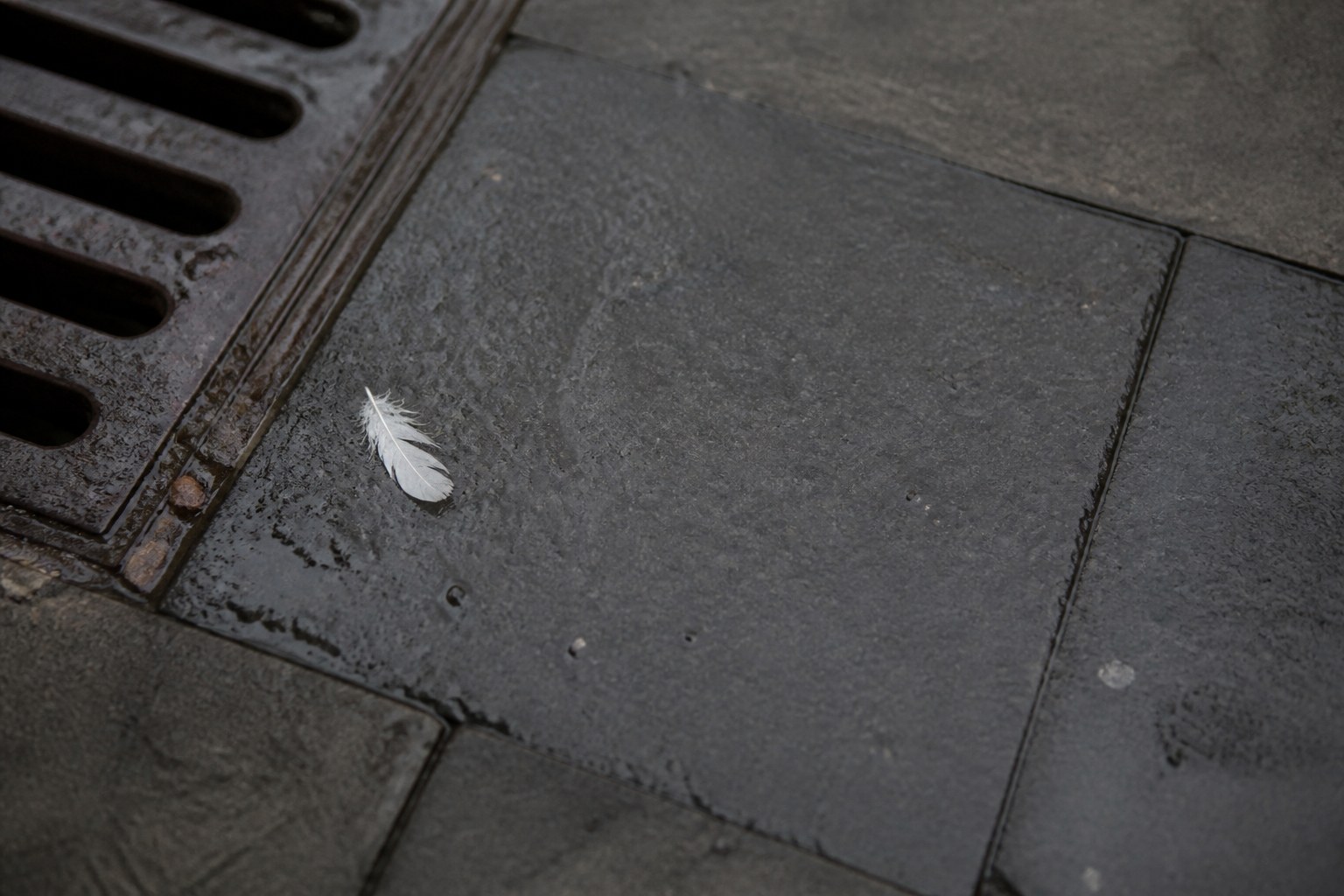
Tracing the source does not decide what the feather means to you. It answers where the feather came from, which is a separate question from why it mattered on the day you found it.
Does a blue, green, or gold feather mean something different from a white one?
Charts that give every feather color a message of its own are a recent addition to angel-sign writing. They differ from one writer to the next, and none of them rests on scripture or on an older tradition.
Most of these charts borrow the associations that angel writers already give to colored light. A blue feather usually takes the calm and protection linked to blue light in the same writing.
Those writers tie blue to Archangel Michael and his role as protector.
A green feather borrows the healing sense of green light in these charts. Archangel Raphael is the figure they pair with green, since his name is usually glossed as "God heals."
Gold feathers take on the sacred brightness of gold light in religious art.
Purple ones lean on the stillness that purple light carries in contemplative writing. Writers who give white feathers purity and innocence are drawing on the wider symbolism of the color white in Christian art and worship.
Is it legal to keep a white feather you found?
A feather from a pillow, a farm bird, or a pet is yours to keep almost anywhere, but wild-bird feathers are different in the United States.
Under the Migratory Bird Treaty Act, keeping feathers of native North American birds without a permit is prohibited, and the U.S. Fish and Wildlife Service states there is "no exemption for molted feathers."
The reason usually given is that no one can tell a feather that fell out naturally from one plucked from a poached bird. A white gull feather picked up on an American beach is therefore illegal to keep, even though the gull dropped it on its own.
The Act does not cover birds that people brought to North America. The Fish and Wildlife Service lists 125 such species, including the rock pigeon and the Eurasian collared-dove, and house sparrows and European starlings fall outside the Act as well.
A white pigeon feather from a city street is therefore legal to keep in the US. Other exceptions cover feathers from legally hunted waterfowl and game birds, and the use of feathers by Native Americans.
In Great Britain, section 1(2) of the Wildlife and Countryside Act 1981 makes it an offence to possess any part of a wild bird. Section 1(3) gives a defense where the bird had not been killed or taken, which covers a feather that simply fell, though selling wild-bird feathers can need a license.
Canada protects most native birds under its own Migratory Birds Convention Act, 1994, and other countries set their own rules. Check with the local wildlife authority before keeping a feather from a wild bird anywhere else.
Before you keep a feather you found
- Which country are you in?
In the US, native wild-bird feathers need a permit; in Great Britain, a feather that fell naturally is covered by the section 1(3) defense.
- Which bird was it?
Pigeon, house sparrow, starling, poultry, or bedding down is fine to keep in the US; gull, egret, owl, and hawk feathers are protected.
- Is there a dead bird nearby?
Leave it. The CDC advises avoiding direct contact with sick or dead wild birds and watching them only from a distance.
- Did you handle it?
Wash your hands with soap and water after touching anything a wild bird has shed.
- Not sure of the species?
Take a photograph and leave the feather. The Fish and Wildlife Service's Feather Atlas can help identify wing and tail feathers later.
A photograph keeps the moment without the legal question, and it costs the bird nothing.
Should you keep the feather, photograph it, or let it go?
What you do with the feather is your own decision, and no religious tradition requires anything of you. People who read it as a sign tend to choose one of a few small responses.
- Keep it in a tin, a book, or a small frame with the date, if the bird it came from allows that where you live.
- Photograph it and leave it where it lay, which suits a feather from a protected wild bird.
- Write it down in a journal with the date, the place, and who or what was on your mind.
- Say a prayer or a word of thanks for the person the feather brought to mind.
- Let it go by returning it to the garden or the wind once it has done its work.
In our view the written note often outlasts the feather.
A feather gets lost in a drawer, while a dated line about who you were thinking of keeps that person in view.
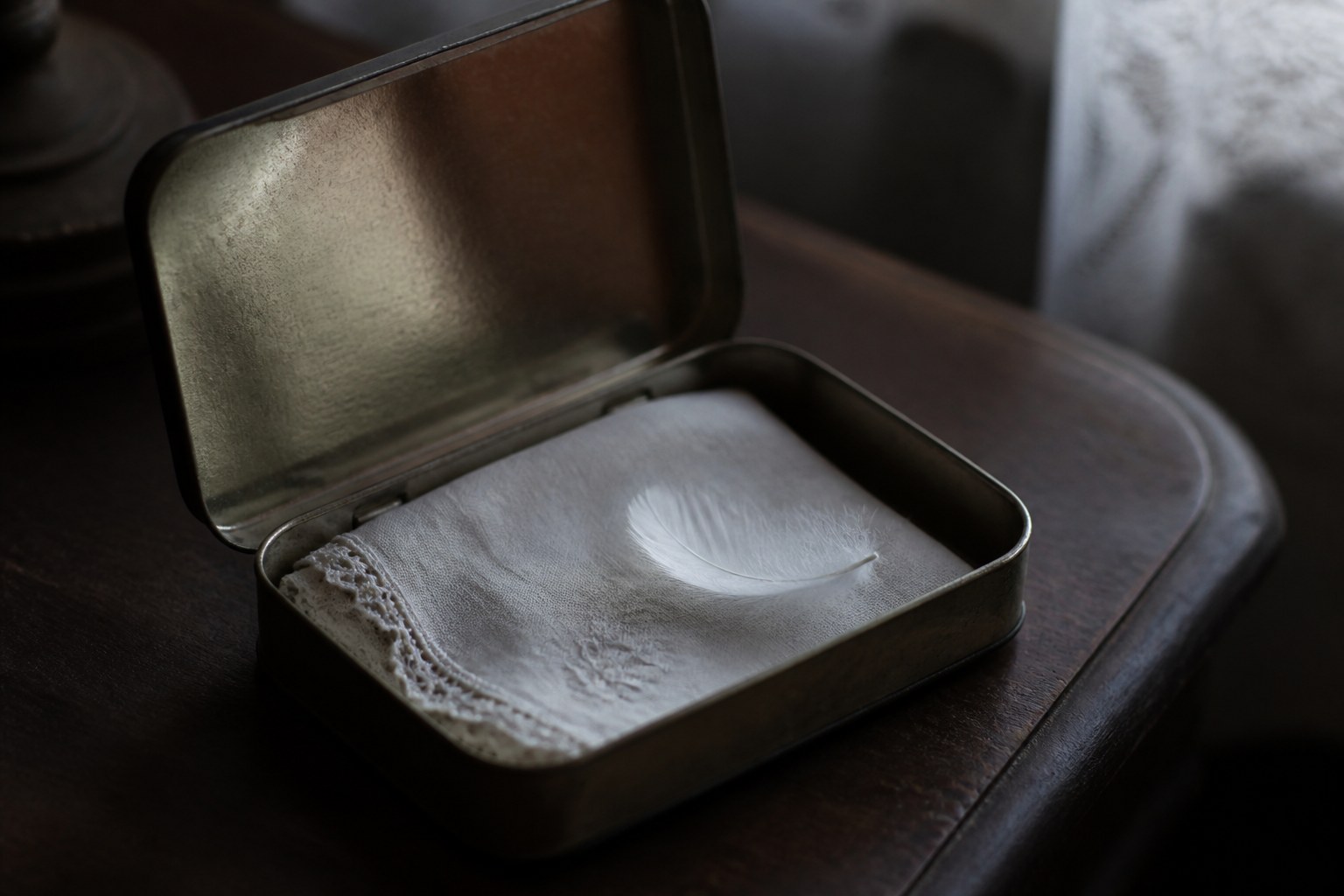
If the feathers have become part of a grief that is not easing, the NHS suggests seeing a GP when low mood has lasted more than two weeks, or when the things you are trying yourself are not helping. A bereavement counselor, or a priest, rabbi, imam, or minister you trust, can stay with the question a feather raised in a way no object can.
Frequently Asked Questions
What does seeing white feathers mean?
In modern angel writing it is read as comfort: a sign that an angel, or someone who has died, is close. That meaning comes from angel books such as Doreen and Charles Virtue's Signs from Above (2009), not from scripture, and most white feathers come from molting birds or feather bedding.
Are white feathers a sign from a loved one who died?
Many grieving people take them that way, and the feather can serve as a keepsake that keeps the person in mind. It cannot show who sent it, so whether it came from a loved one, an angel, or a passing bird is a matter of belief.
Why do I keep finding white feathers in my house?
The usual cause is feather or down bedding, cushions, or jackets, which lose fill through seams and worn covers. A bird that has been in a chimney, loft, or porch can also leave feathers indoors.
Is a white feather bad luck?
No tradition treats a found white feather as bad luck. In Britain it once meant cowardice, because women handed white feathers to men out of uniform during the First World War, so some older families still hear it as an insult.
Can I keep a white feather I found?
It depends on the bird and the country. In the US, feathers from native wild birds such as gulls need a permit even when they fell naturally, while pigeon, starling, house sparrow, and poultry feathers are exempt; in Great Britain a feather that simply fell is covered by a legal defense.
Does the Bible mention white feathers?
No. Isaiah 6:2 describes six-winged seraphs and Psalm 91:4 speaks of shelter under God's wings, but no passage mentions angels leaving feathers or feathers as signs.
Sources
- (2009). Signs from Above: Your Angels' Messages about Your Life Purpose, Relationships, Health, and More, chapter 2, "Finding Feathers," pp. 29-54. Hay House. Link
- . There are signs the angels give us. One of the most common of all is a feather. Angels In My Hair by Lorna Byrne, official Facebook page. Link
- (2008). Angels in My Hair. Doubleday / Penguin Random House. Link
- (2015). "A white feather brings an angel message". Post on X (Twitter), @dianacooper55. Link
- (2013). True Angel Stories: 777 Messages of Hope and Inspiration. Findhorn Press. Link
- (1993). Angels Among Us. Time, December 27, 1993. Link
- (2017). Doreen Virtue's conversion to Christianity sparks debate. The Wild Hunt. Link
- . Isaiah 6:2; Psalm 91:4. New Revised Standard Version Updated Edition. Link
- (1997). White Feathers and Wounded Men: Female Patriotism and the Memory of the Great War. Journal of British Studies 36(2). Link
- . Civilian 'On War Service' Badge From World War 1. IWM, Tracing Your Family History. Link
- (2022). The White Feather Movement. Historic UK. Link
- . The Basics: Feather Molt. All About Birds. Link
- . Feathers and the Law. The Feather Atlas. Link
- (2005). Service Publishes Final List of Non-Native Bird Species. USFWS. Link
- (1981). Wildlife and Countryside Act 1981, section 1(2) and 1(3). legislation.gov.uk. Link
- . Preventing Bird Flu Infections. CDC. Link
- (2026). Behavioral interactions and emotional engagement with loss-related objects in bereavement: associations with grief symptom severity. BMC Psychology. Link
- . Grief after bereavement or loss. NHS. Link
About Our Editorial Process
Every KnowTheAngels guide separates calculation method, tradition context, and personal reflection. We cite where interpretations come from, present more than one view, and never present symbolic reading as prediction.
Read our editorial policy