What Can a Sudden Temperature Change Mean Spiritually?
How to separate a measured room change from warmth, chills, and other body sensations before treating the moment as an angel sign

A sudden warmth, chill, or cold spot has no reliable one-to-one spiritual meaning. Its personal significance may come from what was happening during prayer, grief, or reflection.
The first useful distinction is physical: did the air in the room change, or did your body register heat, cold, goosebumps, or shivering? A thermometer, another person's report, and a check of vents, windows, sunlight, and clothing can answer more than intuition alone.
Body temperature and thermal perception also change for ordinary reasons. Panic can include hot flushes or chills, while fever can make someone feel hot, cold, or shivery, so a spiritual reading should never become a shortcut around health evidence.
You can preserve the moment's personal value by recording what happened and what it brought to mind. That keeps reflection separate from proof.
Quick Facts
- Direct answer
- Warmth or chills may feel spiritually significant, but they do not carry one fixed message
- First distinction
- Separate an ambient room change from a sensation in your skin or body
- Simple checks
- Look for airflow, sunlight, clothing, movement, stress, and whether anyone else notices the change
- Health boundary
- Fever, panic, cold intolerance, and cold exposure can all change how hot or cold you feel
- Best use
- Treat the event as a prompt for careful observation rather than a command or prediction
Did the Room Temperature Change, or Did Your Body Feel Different?
A room-temperature change is an environmental claim, while feeling suddenly warm or cold is a report about your body. Neither one proves the other even when they occur together.
If another person near the open window reports the same draft, you have a shared observation. If a thermometer records a change, you have measured evidence about the room.
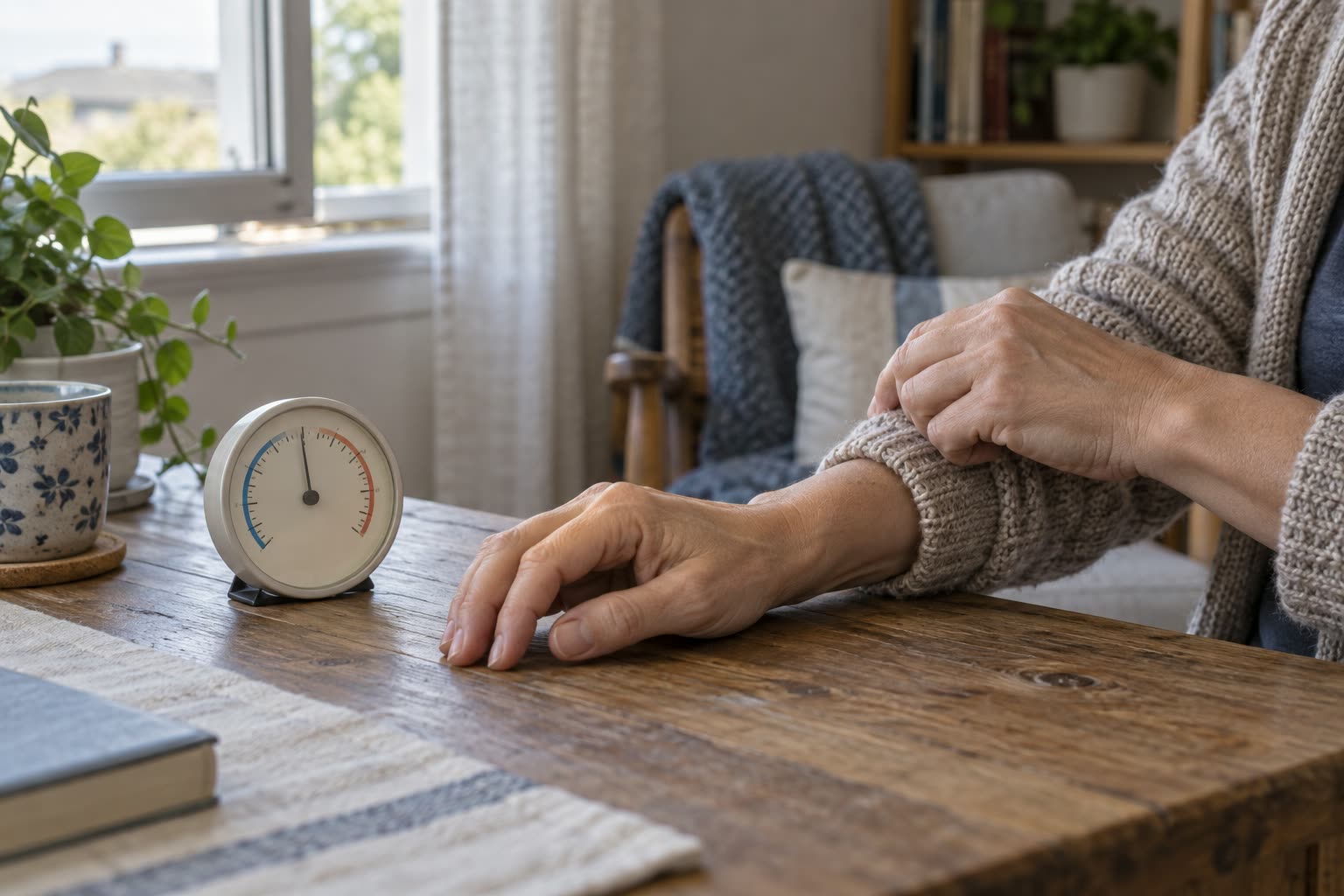
A cold patch on one hand, a warm face, goosebumps on both arms, and whole-body shivering describe different sensory events.
Precise language prevents a quick story about presence from absorbing several possible causes.
Tingling or pins and needles is a separate sensory report rather than a temperature change, even when it happens at the same time.
A thermometer can confirm that the air changed without explaining why. A vent cycle, opening door, sun passing behind cloud, or movement between rooms offers the next test.
If only you felt the change, the experience is still real as a sensation.
Write it as “I felt cold” rather than “the room became cold” unless measurement supports the second statement.
What Ordinary Causes Can Produce Sudden Warmth or Chills?
Start with the observation: air movement, radiant heat, clothing, recent activity, emotion, and illness can all change thermal experience. The right first check depends on whether the room, the skin, or the whole body seems to be involved.
Romanovsky's review explains that thermal perception draws on signals from the skin as well as the body's temperature-regulation systems. That is why a cold draft across one arm can feel dramatic without changing the room as a whole.
The NHS lists both hot flushes and chills among possible panic-attack symptoms, while warning that similar symptoms can occur with other conditions.
Fever can also produce mixed sensations. NHS guidance usually treats 38°C or above as a high temperature, but notes that someone may feel hot, cold, or shivery even when a thermometer reads below that threshold.
| What you noticed | Useful first evidence | What it does not prove |
|---|---|---|
| One cold area in a room | Vent, window, door, surface temperature, and whether others feel it | A spirit or angel in that location |
| Warm face or skin | Activity, clothing, room heat, emotion, and other symptoms | Approval or healing |
| Chills or shivering | Cold exposure, fever check, anxiety context, and how long it lasts | Danger from a negative presence |
| Goosebumps | Cold air or a strong emotional response | A message with fixed content |
These checks keep the interpretation proportionate to what you actually observed without explaining away a meaningful moment.
Why Do People Give Temperature Changes Spiritual Meaning?
Warmth and cold already carry emotional associations in ordinary speech. People describe welcome as warm, rejection as cold, comfort as warmth, and fear as a chill, so those familiar metaphors are ready when an unexplained sensation occurs.
Zickfeld and colleagues found that strong self-reported experiences of kama muta, often described as being moved, were associated with increased skin temperature and piloerection. This helps explain why an emotionally charged moment may feel physically marked.
An emotionally charged setting can supply the association: warmth may feel comforting during prayer, while a chill may accompany awe or fear. That association is personal and contextual, not a shared code.
Interpretation also depends on the beliefs a person brings to the event. A guardian-angel tradition, a ghost story, and a physiological explanation do not supply interchangeable evidence.

The spiritual value, when there is one, lies in the question the sensation opens.
A warm feeling during grief might invite you to notice comfort, while a chill during a difficult memory might reveal fear or alertness without predicting what happens next.
Because the associations are learned and context-dependent, cold does not automatically mean danger and warmth does not automatically mean a benevolent presence. Keep the reflection tied to the memory, prayer, or situation that gave the sensation its emotional force.
What Do Cold Spots Mean in Spirit and Angel-Sign Lore?
Cold spots are common in ghost and spirit lore, where a localized drop in temperature is often treated as evidence that an unseen presence has entered a room.
An angel-sign reading adds another interpretive step because the temperature report itself contains no information about who or what caused it.
A sensation cannot function as a reliable code when different interpreters assign opposing messages to the same event.
Dagnall and colleagues' environmental appraisal of allegedly haunted houses records reports of unusual temperature and air movement, but it also considers expectation, fear, suggestion, building conditions, and other environmental factors.
Cold-spot lore and the evidence boundary
The report, the room conditions, and the later interpretation are three separate kinds of information.
What the evidence supports
- A recurring convention
People in haunted-place and spirit narratives often report localized cold or moving air.
- A testable environment
Drafts, ventilation, doors, windows, and surface temperatures can create uneven conditions.
- A strong subjective effect
Fear and expectation can influence which sensations receive attention and how they are described.
What remains limited
- No identity test
A temperature reading cannot distinguish an angel, ghost, emotion, or building cause.
- No moral code
Cold does not prove a negative presence, and warmth does not prove a benevolent one.
- No future message
The event does not supply a warning, promise, or prediction.
If a cold area repeatedly appears in the same physical location, investigate the location first. A repeatable draft is evidence about the building, not stronger evidence about a presence.
What Can Warmth or Chills During Prayer Mean?
Warmth or chills during prayer can be meaningful as part of a person's devotional experience, but the meaning comes from context: the prayer, tradition, emotion, and later reflection rather than a universal temperature code.
Religious texts and communities use bodily language differently. Qur'an 39:23 describes skin shivering and then softening at remembrance of God, while Joel Inbody's study shows how Pentecostal participants interpreted bodily sensations through language learned in their congregation.
Neither example provides an angel-identification method because the Qur'anic verse concerns response to revelation and remembrance, while the ethnographic study describes interpretation inside a particular Christian setting.
Prayer also concentrates attention and emotion. A quiet room, still posture, grief, hope, fear, or relief may make warmth, chills, or goosebumps more noticeable at the same time that the words feel important.
Meditation can also increase attention to subtle sensations, although its aims and methods differ from prayer. Warmth is not a score showing that either practice worked correctly.
- Room: Check the window, vent, sunlight, heater, and whether anyone else noticed a change.
- Body: Note whether you felt warmth on the skin, goosebumps, sweating, chills, or whole-body shivering.
- Context: Record clothing, posture, recent movement, strong emotion, and any other symptoms.
- Interpretation: Write the personal association only after the observable details, and keep it open to revision.
A restrained account names what the sensation accompanied. You can say that warmth arrived while praying for courage and that the moment felt comforting, without saying an angel guaranteed safety or a particular outcome.
No sensation is required for prayer to be sincere.
The absence of warmth, chills, or any unusual feeling says nothing about a person's faith, worth, or whether the prayer mattered.
How Can You Check and Reflect on an Unexplained Temperature Shift?
Record the observation first, before choosing an explanation. This preserves the difference between what happened, what you felt, and what you later thought it meant.
A repeatable observation log
Use the same fields each time so later entries can be compared without changing the method.
- Time
- Input
- Date and clock time
- Action
- Record when the change began
- Result
- Later entries can reveal a time-of-day pattern
- Place
- Input
- Room and exact position
- Action
- Note where you were standing or sitting
- Result
- A location-bound pattern becomes visible
- Duration
- Input
- Start and stop points
- Action
- Estimate how long the change lasted
- Result
- A brief wave stays distinct from a persistent feeling
- Change
- Input
- What shifted immediately before or after
- Action
- Record the one observable difference
- Result
- The entry preserves a testable sequence
- Compare
- Input
- Later entries
- Action
- Compare time, place, duration, and recurrence
- Result
- Repeated and one-off events no longer blur together
Keep high-stakes decisions tied to ordinary evidence. A temperature sensation may prompt prayer or reflection, but it should not decide whether to stop treatment, confront someone, spend money, or enter an unsafe place.
When Are Hot, Cold, or Shivery Feelings a Health Concern?
Use medical guidance when heat, cold, or shivering is persistent, recurrent, severe, or accompanied by other worrying symptoms. A symptom that follows you between rooms carries different evidence from one that stops when you leave a draft.
For possible fever, the NHS usually treats 38°C or above as a high temperature and advises urgent help when a fever is not improving or is getting worse. Feeling hot, cold, or shivery can still matter below 38°C, so the number should be read with the full symptom picture.
Frequent or extreme cold intolerance also deserves assessment because several health conditions can affect temperature sensitivity.
The purpose of that advice is evaluation, not self-diagnosis from a list.
After cold exposure, confusion, fumbling hands, memory loss, slurred speech, or drowsiness can be warning signs of hypothermia. CDC guidance says to seek immediate medical attention, so contact local emergency services rather than continuing a symbolic reading.
Unresolved is an honest answer when environmental and health checks do not reveal a cause.
Frequently Asked Questions
Is suddenly feeling cold a spiritual sign?
It can carry personal spiritual meaning when prayer, grief, or another context makes the moment significant. Check the room, body, emotion, and other symptoms before keeping that interpretation.
Does a cold spot mean a negative spirit is nearby?
No reliable evidence connects a cold spot with a negative spirit. Drafts, ventilation, surfaces, expectation, and bodily perception can all contribute, so a cold spot should not become a moral label for a place or presence.
What does sudden warmth during prayer mean?
Warmth during prayer may feel comforting or emotionally important. Describe the prayer and the feeling separately, then keep any meaning personal and proportionate.
Are chills, shivering, and goosebumps the same thing?
Chills describe feeling cold, shivering is repeated muscle movement, and goosebumps are raised skin around hair follicles. They can occur together, but each observation points to a different first question.
Can a thermometer prove a spiritual temperature change?
A thermometer can show that the local air or a surface changed temperature. It cannot identify why the change occurred or connect it to an angel, spirit, message, or moral meaning.
Sources
- (2023). High temperature (fever) in adults. NHS. Link
- (2023). Panic disorder. NHS. Link
- (n.d.). Chills. U.S. National Library of Medicine. Link
- (n.d.). Cold intolerance. U.S. National Library of Medicine. Link
- (n.d.). Recognizing Hypothermia. CDC. Link
- (2014). Skin temperature: its role in thermoregulation. Acta Physiologica. Link
- (2020). Tears of joy, aesthetic chills and heartwarming feelings: Physiological correlates of Kama Muta. Psychophysiology. Link
- (2020). Things That Go Bump in the Literature: An Environmental Appraisal of “Haunted Houses”. Frontiers in Psychology. Link
- (2015). Sensing God: Bodily Manifestations and Their Interpretation in Pentecostal Rituals and Everyday Life. Sociology of Religion. Link
- (n.d.). Surah Az-Zumar 39:23. Quran.com. Link
About Our Editorial Process
Every KnowTheAngels guide separates calculation method, tradition context, and personal reflection. We cite where interpretations come from, present more than one view, and never present symbolic reading as prediction.
Read our editorial policy